

For many years, asset management was viewed primarily as the responsibility of maintenance and engineering teams. Their role was to keep equipment running, respond to failures, and extend the life of critical assets. While those responsibilities remain essential, the expectations placed on asset management have changed significantly.
Today, organizations operate in an environment of rising costs, supply chain uncertainty, increasing regulatory requirements, and growing pressure to improve productivity. In this context, asset management is no longer simply about maintaining equipment—it is about enabling better business decisions.
Every investment in physical assets affects financial performance, operational resilience, and long-term competitiveness. As a result, asset management has become a strategic capability that reaches far beyond the maintenance department.
Every department influences asset performance
Asset-intensive organizations often assume that maintenance alone determines equipment reliability. In reality, the performance of an asset is shaped by decisions made across the business.
Finance determines how capital is allocated and which investments receive funding. Procurement influences equipment quality, supplier relationships, and the availability of critical spare parts. Human Resources is responsible for recruiting, developing, and retaining the technical skills needed to operate and maintain increasingly sophisticated assets.
Operations plays an equally important role. Even well-maintained equipment will experience premature failures if it is operated outside its intended parameters or if production priorities consistently override maintenance requirements.
Information Technology has also become a key contributor. Modern asset management depends on accurate data, connected systems, cybersecurity, and digital tools that support informed decision-making.
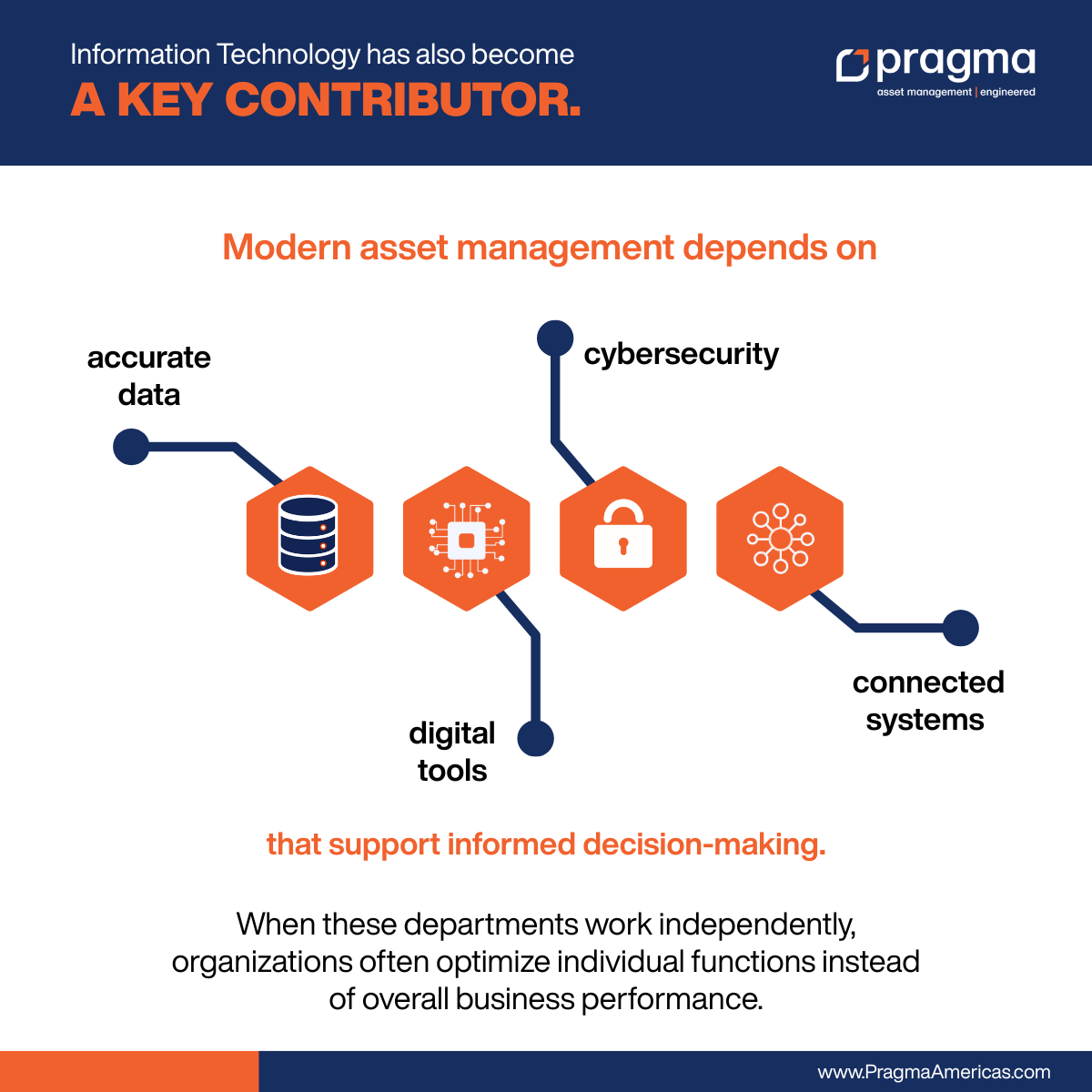
When these departments work independently, organizations often optimize individual functions instead of overall business performance.
Breaking down organizational silos
One of the biggest barriers to effective asset management is organizational misalignment.
Procurement may focus on minimizing purchase costs, while maintenance prioritizes reliability. Operations may push for maximum production, even when preventive maintenance is overdue. Finance may reduce maintenance budgets without fully understanding the long-term impact on asset condition and operational risk.
None of these decisions are inherently wrong. Each department is pursuing legitimate objectives. The problem arises when those objectives are not aligned around a common business strategy.
Successful organizations recognize that asset management requires collaboration. Decisions about maintenance, investment, operations, technology, and risk cannot be made in isolation because every choice influences performance, cost, and reliability elsewhere in the organization.
Aligning asset management with business objectives
The most effective asset management strategies begin with the organization’s broader goals.
Is the priority to increase production capacity? Extend asset life? Improve safety? Reduce operating costs? Support sustainability initiatives? The answers to these questions should shape maintenance priorities, capital investment decisions, workforce planning, and technology adoption.
This alignment also improves decision-making. Rather than reacting to equipment failures or budget constraints, organizations can evaluate trade-offs based on long-term value creation. Investments become easier to justify because they are linked to measurable business outcomes instead of isolated maintenance activities.
The AMIP 5 framework reflects this broader perspective by assessing not only technical practices but also the organizational capabilities that support asset performance, including strategy, risk management, technology, people, information, and contractor management. Its objective is to help organizations understand how these interconnected areas contribute to overall business performance.
Looking beyond the maintenance department
Organizations that consistently outperform their peers understand that asset management is not an operational expense to be controlled—it is a strategic capability to be developed.
When finance, operations, procurement, IT, engineering, and executive leadership share a common understanding of asset management priorities, organizations make better investment decisions, reduce operational risk, improve reliability, and create greater long-term value from their assets.
The conversation has evolved. Asset management is no longer simply about fixing equipment. It is about creating an organization where every function contributes to the performance, resilience, and sustainability of the business.
