

Predictive Accuracy: How Condition Monitoring Transforms Maintenance Strategies in Industry 4.0
Decoding Industry 4.0: The Rise of Condition Monitoring
The fourth industrial revolution, or Industry 4.0, is marked by the integration of digital technologies into industrial processes, reshaping the asset management environment. This integration has opened new opportunities for organizations to increase efficiency and productivity, and condition monitoring has become a preferred maintenance technology in the Industry 4.0 era.
The fourth industrial revolution, or Industry 4.0, is marked by the integration of digital technologies into industrial processes, reshaping the asset management environment. This integration has opened new opportunities for organizations to increase efficiency and productivity, and condition monitoring has become a preferred maintenance technology in the Industry 4.0 era.
Condition monitoring is a proactive maintenance approach that involves regularly assessing the health and performance of machinery, equipment, or systems to identify potential problems before they lead to unplanned downtime or catastrophic failures. Condition monitoring involves collecting and analyzing equipment data to detect early signs of wear, defects, or other issues that could lead to equipment failure and provide an accurate estimate of an asset’s remaining useful life. This article will explore how condition monitoring is leading proactive maintenance.
Beneath the Surface: Navigating the PF Curve Probability
Condition-based maintenance aims to define the appropriate condition-monitoring technology for critical equipment and to set the measurement interval so that potential failures can be detected early. With this knowledge, you can plan and schedule corrective action (e.g., replacing a bearing that is beginning to fail) before it becomes an actual failure and your machine breaks down during production.
Condition-based maintenance aims to define the appropriate condition-monitoring technology for critical equipment and to set the measurement interval so that potential failures can be detected early. With this knowledge, you can plan and schedule corrective action (e.g., replacing a bearing that is beginning to fail) before it becomes an actual failure and your machine breaks down during production.
The theory of condition monitoring is illustrated by the PF Curve (PF: Potential Failure) in Figure 1. The PF curve is a graphical representation that helps demonstrate the health of an asset over time and indicates when potential failures are likely to be identified (detected) (point P in Figure 1) and the period before a complete functional failure (point F in Figure 1). Different condition monitoring techniques can detect point P earlier on the PF curve by monitoring various parameters and detecting different failure modes.
The PF Curve
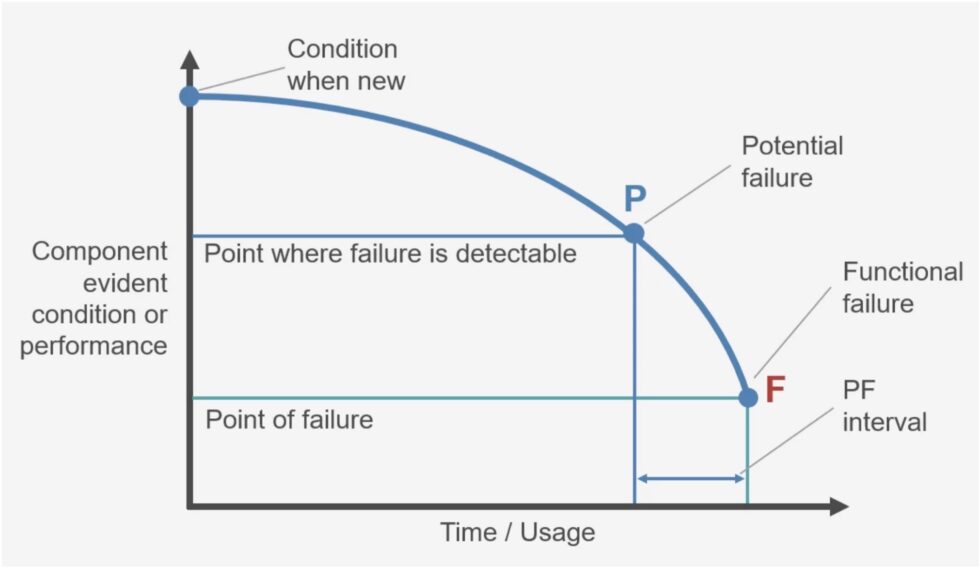
Figure 1: The PF Curve
The benefit of condition monitoring (within a condition-based maintenance (CBM) program) is that it achieves the best balance between maintenance costs and equipment reliability. An alternative to CBM is reactive maintenance, which is best described as waiting for an asset to fail before maintaining or repairing it. Selecting reactive maintenance as a strategy can help you achieve the maximum useful life from components. However, consider the downsides of costly production downtime and high transportation costs for spare parts.
Another tactic is use-based maintenance (UBM), which uses statistical data to schedule maintenance tasks. An example is replacing motors in the plant every six months because, based on past experience, that is when motors in that application begin to fail. Using UBM allows you time to avoid unplanned production downtime, but it increases an organization’s spending on spare parts and maintenance labor.
With CBM as a tactic, maintenance intervals can be optimized based on the machine’s actual condition, preventing production downtime and maximizing the lifespan of machine components. For example, if a motor is monitored using vibration analysis and a bearing defect is detected, it can be replaced during planned maintenance, preventing a catastrophic failure that would require unplanned downtime and costly repairs, and improving overall equipment effectiveness (OEE).
By addressing potential problems early, organizations can prevent further damage to equipment and extend the asset’s lifespan. This can help reduce replacement costs and improve the equipment’s return on investment (ROI). Early detection of potential failures can also help improve safety by identifying and addressing problems before they become hazardous to workers or the environment.
Technology Toolbox: Choosing the Right Condition Monitoring Technology
The choice of condition monitoring technology depends on several factors, such as the type of equipment, its criticality, accessibility, and expected failure modes. Several condition monitoring technologies are available; some of the most common are listed below.
The choice of condition monitoring technology depends on several factors, such as the type of equipment, its criticality, accessibility, and expected failure modes. Several condition monitoring technologies are available; some of the most common are listed below.
