

Measuring and managing organizational performance is essential to driving business success.
Management teams need to make fact-based decisions supported by reliable Key Performance Indicators (KPIs). In medium-sized and large organizations operating across multiple countries and industries, consistent performance evaluation is often a significant challenge for executives.
Organizations with a history of mergers and acquisitions face additional complexities in standardizing performance measurement, as individual business units may already have their own KPI frameworks in place.
A structured approach to developing and implementing an Asset Management (AM) Scorecard can help position an organization for long-term success.
The Approach
Successful Asset Management Scorecard initiatives balance the short-term need to track quick wins with the implementation of a comprehensive set of Asset Management KPIs. These indicators must be capable of monitoring progress against strategic objectives and driving the desired behaviors throughout the organization.
Effective change management plays a critical role in addressing resistance to change and embedding performance measurement into the operational culture.
A structured approach supports organizations transitioning toward a new and improved set of KPIs. Figure 1 illustrates this approach.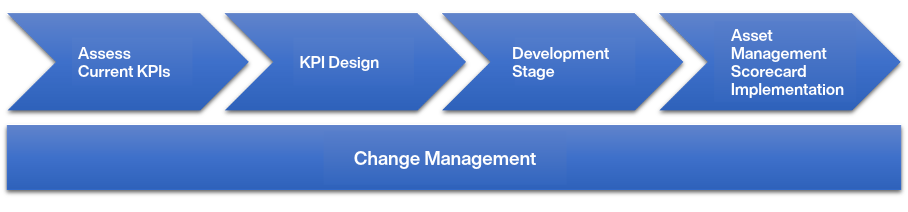
Figure 1. Structured Approach to Asset Management Scorecard Development and Implementation
Assessing Current Key Performance Indicators (KPIs)
Organizations without performance measurement systems are rare today. However, an organization’s existing set of KPIs should be regularly reassessed, particularly at the beginning of an Asset Management improvement initiative, such as the development of an updated AM Scorecard.
Before attempting to change the metrics used to track or monitor performance, Asset Management professionals must first understand the KPIs currently in use.
These indicators are often deeply embedded in an organization’s culture. Existing KPIs can either support implementation—for example, by adopting effective indicators across business units and sites—or become barriers to introducing a new scorecard.
Key KPIs should be reinforced to support quick wins. Indicators that could hinder implementation must be identified early, allowing Asset Management professionals to develop an appropriate strategy for managing the required changes.
KPIs linked to employee incentives, particularly those involving unionized workers, require proactive stakeholder engagement.
Assessing the current KPI framework should also be viewed as an opportunity to engage stakeholders and gather firsthand feedback on what is working effectively and what needs to be changed or improved.
This engagement should take place across multiple organizational levels and all affected functions.
Investing time in this activity delivers significant benefits during the subsequent development and implementation stages. However, stakeholder engagement alone does not replace a comprehensive change management strategy.
Designing Key Performance Indicators (KPIs)
Once the existing KPIs are understood, they can serve as a starting point for stakeholder discussions aimed at defining the Asset Management Scorecard that will drive performance. An Asset Management framework, as illustrated in the figure below, is recommended for identifying gaps within the existing KPI structure.
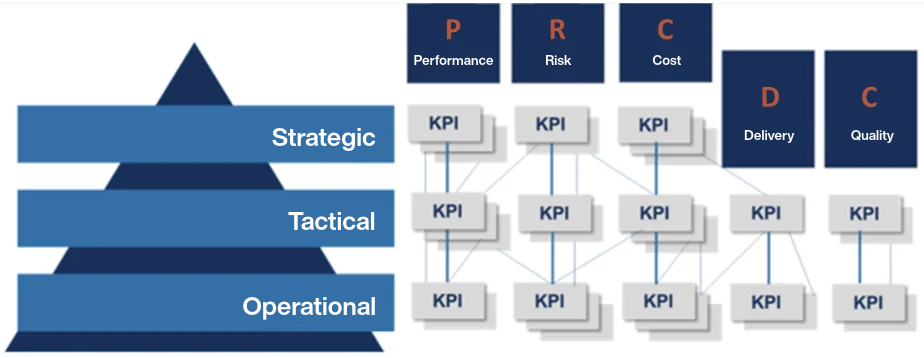
Before developing the KPI framework, both organizational and Asset Management objectives must be clearly defined and documented.
Every KPI included in an Asset Management Scorecard must align with these objectives, regardless of the framework used to evaluate and define performance indicators.
KPIs should be developed across three organizational levels:
-
Strategic level: Senior management and executive leadership.
-
Tactical level: Middle management.
-
Operational level: Frontline teams and operational personnel.
Individuals and teams must be evaluated using KPIs whose outcomes they can directly influence.
When designing a KPI framework, the maturity of business processes must also be considered to ensure that the indicators are practical and achievable.
Introducing advanced performance measures into immature business processes or functions can significantly hinder stakeholder adoption.
All designed KPIs must be formally documented, including their definitions, calculation formulas, reporting frequency, and data sources.
Development Stage
Defining a set of KPIs is only one part of preparing to implement an improved Asset Management Scorecard.
Further development is required to make the indicators established in the previous stage operational and measurable.
Asset Management professionals must determine how KPIs will be reported, what performance targets should be established, and how the supporting information will be managed.
These development activities are explored in the following sections.
Scorecard and Reporting Development
Numerous reporting and Business Intelligence (BI) tools are available today, providing organizations with platforms for configuring reports, dashboards, scorecards, and data analytics.
In large organizations, these tools should be leveraged to standardize and automate performance reporting.
Labor-intensive, Excel-based reporting processes should be avoided wherever possible, as they often struggle to deliver timely information and may be vulnerable to manual manipulation.
Selecting the appropriate software platform is a critical success factor in implementing an Asset Management Scorecard.
The desired functionality should be the primary consideration when evaluating available software solutions.
Failing to make effective use of existing software capabilities can lead organizations into months of unnecessary custom development and end-user frustration.
Asset Management professionals should consider the following factors when selecting a software solution or reporting platform:
-
Ease of developing and generating reports and dashboards.
-
Ability for power users to configure dashboards and reports.
-
Integration capabilities with existing information systems, including ERP, MES, EAMS, and SCADA. Integration through multiple protocols and platform independence are highly desirable.
-
Automated reporting and alerts.
-
System scalability.
-
Mobile functionality.
-
Easy access to information from any device.
-
Technical support and an active developer community.
Once an Asset Management performance reporting platform has been selected, dashboards should be configured to support performance monitoring at executive, middle-management, and operational levels.
Each dashboard must be optimized to present only the information relevant to its intended users.
It is essential that all dashboards and scorecards provide a single source of truth, ensuring consistency and alignment across data sources and calculations.
Established Asset Management software solutions, such as On Key Insights, address the requirements outlined above.
A key differentiating factor is often the service provider’s ability to translate business requirements into an effectively configured and implemented system.
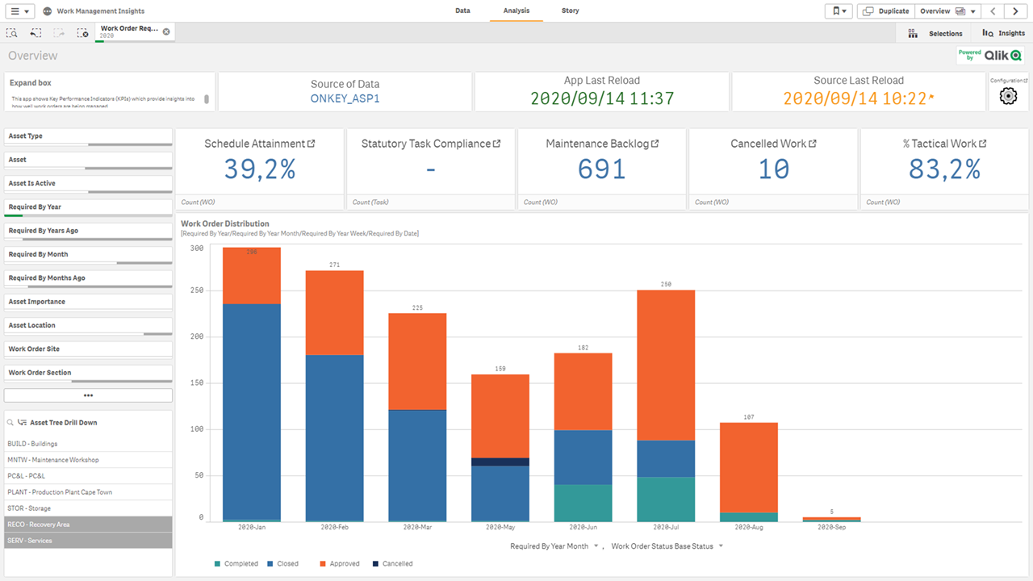
Figure 2. On Key Insights dashboard providing an operational view of Work Management KPIs and work distribution.
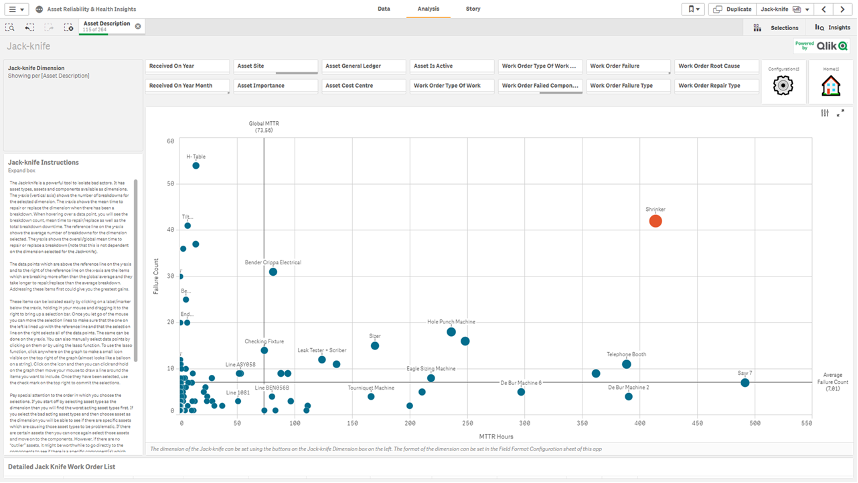
Figure 3. On Key Insights Reliability Dashboard using Jackknife Analysis.
Setting Performance Targets
When supervisors or managers encounter a new KPI, their first question is often: “What does good performance look like for this indicator?”
Asset Management consultants and professionals should aim to establish realistic, achievable targets that encourage the desired behaviors and performance improvements.
These targets should be defined either before organization-wide implementation or during the early stages of the Asset Management Scorecard rollout.
Asset Management professionals can use several approaches to establish performance targets:
-
External benchmarking: Comparing performance against organizations within the same industry.
-
Internal benchmarking: Collecting internal performance data during an initial trial or baseline period.
-
Modeling and simulation: Using analytical methods to establish appropriate performance expectations.
Information Strategy
Strong and effective data governance is a critical enabler of an Asset Management Scorecard, ensuring that performance indicators remain relevant, reliable, and accurate.
An organization’s information strategy should be updated to support the Asset Management Scorecard and clearly define:
-
Data inputs and source systems.
-
Roles and responsibilities for ensuring data integrity.
-
Data capture methods for critical transactions.
-
Data quality controls.
-
Data timeliness requirements.
-
Accountability for collecting and distributing KPIs.
-
Information retention and security policies.
-
Information auditing requirements.
Change Management
Change management is essential to the successful implementation of any Asset Management initiative, including changes to Asset Management KPIs.
Ineffective organizational change management can lead employees to become disengaged, apathetic, or resistant to adopting a new and improved Asset Management Scorecard.
A formal change management methodology, such as ADKAR (Awareness, Desire, Knowledge, Ability, and Reinforcement), should be incorporated into the initiative.
Identifying and empowering change champions at each site is essential to driving the required organizational changes.
The way an organization proactively addresses resistance to change will significantly influence the effectiveness of its Asset Management Scorecard implementation.
Implementing the Asset Management Scorecard
After assessing the organization’s current state, defining an optimized Asset Management Scorecard, developing dashboards and reports, establishing KPI targets, and preparing the business for change, the organization is ready to begin implementation.
However, Asset Management professionals should resist the temptation to introduce every change simultaneously.
A phased implementation approach is recommended to validate concepts, demonstrate early results, and build momentum.
This approach also helps prevent stakeholders from becoming overwhelmed by the scale of change.
KPIs should be prioritized according to their strategic importance to the business, with implementation beginning at strategically selected sites.
Change management efforts should be intensified during this stage, focusing on securing management commitment in the early phases and encouraging acceptance of the new KPIs.
Senior management support is a critical outcome of effective change management.
However, visible evidence that executives and senior leaders actively use KPIs and make decisions based on the new Asset Management Scorecard has an even greater positive influence on implementation success and long-term sustainability.
Simple tools, such as visual management boards, should be used to ensure that KPIs are visible and accessible to employees.
The more effectively KPIs are communicated and made available to employees, the greater their engagement—and the stronger the organization’s performance outcomes.
